
Dr Suraj Manjunath, Surgical Oncologist at Apollo Hospitals, offers Salivary Gland Tumors treatment in Bangalore, including evaluation and surgery for benign and cancerous tumors. Treatment depends on the tumor’s type, location, and extent, with careful attention to preserving facial nerve function, swallowing, and appearance. Some patients may need radiation or other treatments alongside surgery.


Saliva keeps your mouth moist, helps you chew and swallow, and supports oral health. You have three main pairs of salivary glands:
There are also many small, or minor, salivary glands throughout the lining of the mouth and throat.
A tumor develops when cells in one of these glands grow abnormally. Benign tumors are noncancerous. Malignant tumors are cancerous and may grow into nearby tissues or spread elsewhere.
Examples include benign pleomorphic adenoma and Warthin tumor, and cancers such as mucoepidermoid carcinoma and adenoid cystic carcinoma. These names describe different diseases; they do not all behave alike.
The gland involved, tumor type, and relationship to nearby nerves influence treatment. A painless or slow-growing lump still needs evaluation because symptoms alone cannot reliably distinguish benign disease from cancer.
You can explore the Head & Neck Cancers section within Cancers We Treat for related information.

A lump near your ear, beneath your jaw, or inside your mouth can be worrying. You may get thoughts like “Is it cancer?” “Will surgery affect my face?” “Can the gland be preserved?”.
These are understandable questions. Salivary gland tumors develop close to important nerves and structures, so concerns about smiling, speaking, eating, and appearance deserve careful discussion.
The first thing I want you to understand is that a salivary gland tumor does not always mean cancer. The right next step is to establish what the swelling is and whether treatment is needed.
I am Dr. Suraj Manjunath, a Surgical Oncologist in Bangalore, associated with Apollo Hospitals, Bannerghatta Road and Apollo Hospitals, Sarjapur Road.
My approach is to explain your diagnosis clearly, assess whether surgery will help, and plan treatment with attention to cancer control, facial movement, swallowing, and appearance.
As a salivary gland tumors surgeon in Bangalore, my role begins with reviewing your symptoms, examining the swelling, and studying your scans and biopsy findings. I will explain what the reports show, where uncertainty remains, and whether further tests would change the treatment plan.
Some tumors need surgery. Others may be monitored after a reliable diagnosis and an assessment of the risks. Cancerous tumors may require surgery followed by additional treatment.
You do not need to understand every medical term before your consultation. We can work through the information together and focus on the decisions that matter.

+

+

+

+

Salivary gland tumors can cause different symptoms depending on their location and size. Possible warning signs include:
These symptoms can also occur with infections, salivary stones, and other noncancerous conditions. An examination helps identify the cause.
I am particularly concerned when a swelling grows rapidly, becomes painful, or is accompanied by facial weakness. Please arrange prompt assessment rather than waiting for it to settle.
If you already have a biopsy report showing a salivary gland tumor, further planning is important even if you feel well. Breathing difficulty or an inability to swallow liquids requires urgent medical attention.

Clinical examination
I examine the gland, mouth, neck, and facial movements. I also ask about growth, pain, previous treatment, and changes in swallowing or facial function.
Ultrasound and other scans
Ultrasound can assess a superficial swelling and guide a needle sample. MRI may help define deeper disease or possible nerve involvement. CT can provide additional information about the neck, surrounding structures, or bone.
Needle biopsy
Fine-needle aspiration uses a thin needle to collect cells. A core needle biopsy collects a small piece of tissue and may be useful when more information is needed. An unclear result may require repeat sampling or specialist pathology review.
The biopsy method should be planned carefully, particularly for a lump in a major salivary gland.
Pathology and staging
The pathologist identifies the tumor type and, where possible, its grade—how aggressive the cells appear. If cancer is diagnosed, staging assesses its extent, including nearby lymph nodes and possible distant spread. Chest imaging or PET-CT is selected according to the findings; every patient does not need every scan.
Fitness assessment
Before surgery, we review medical conditions, medications, nutrition, blood tests, and anesthesia fitness. Together, these findings guide a safer, more appropriate plan.


Where appropriate, I discuss treatment with head and neck surgical colleagues, radiation and medical oncologists, radiologists, and pathologists. Reconstruction, dental care, nutrition, and swallowing support may also be needed.
Discuss your case through a multidisciplinary review before choosing a treatment approach.
Parotid gland surgery
A superficial parotidectomy removes the outer portion of the parotid gland. A total parotidectomy removes both its outer and deeper portions. The extent is chosen according to the tumor rather than assuming that every patient needs the entire gland removed.
The facial nerve, which controls facial movement, passes through the parotid gland. Preserving it is a major consideration. When it is functioning normally and can be separated safely from the tumor, preservation is the goal. If cancer directly involves the nerve, removing an affected segment may be necessary. Repair or rehabilitation options should be discussed beforehand.
Submandibular and sublingual gland surgery
Surgery generally removes the affected gland, with surrounding tissue when required for cancer clearance. Nearby nerves involved in lower lip movement, tongue movement, and sensation need careful consideration.
Minor salivary gland surgery
These tumors may occur in the palate, mouth, or throat. Surgery removes the tumor with an appropriate surrounding margin. Larger defects may need reconstruction to support speech, swallowing, and healing.
Neck dissection
This removes selected groups of neck lymph nodes when cancer has spread to them or when the risk of hidden spread justifies treatment. It is not necessary for every patient.
Before surgery, I explain what we expect to remove, what we aim to preserve, and which findings could change the operation.

Open surgery
Open surgery remains the standard approach for most major salivary gland tumors. It provides direct access to the gland, facial nerve, blood vessels, and neck lymph nodes when needed.
For parotid surgery, the incision is usually placed around the ear and may extend into the neck. Its design depends on the access required and the individual anatomy. In carefully selected cases, cosmetic incision approaches like the mini-incision parotidectomy, modified facelift incision or a retroauricular hairline incision are used to perform the surgery.
Robotic surgery
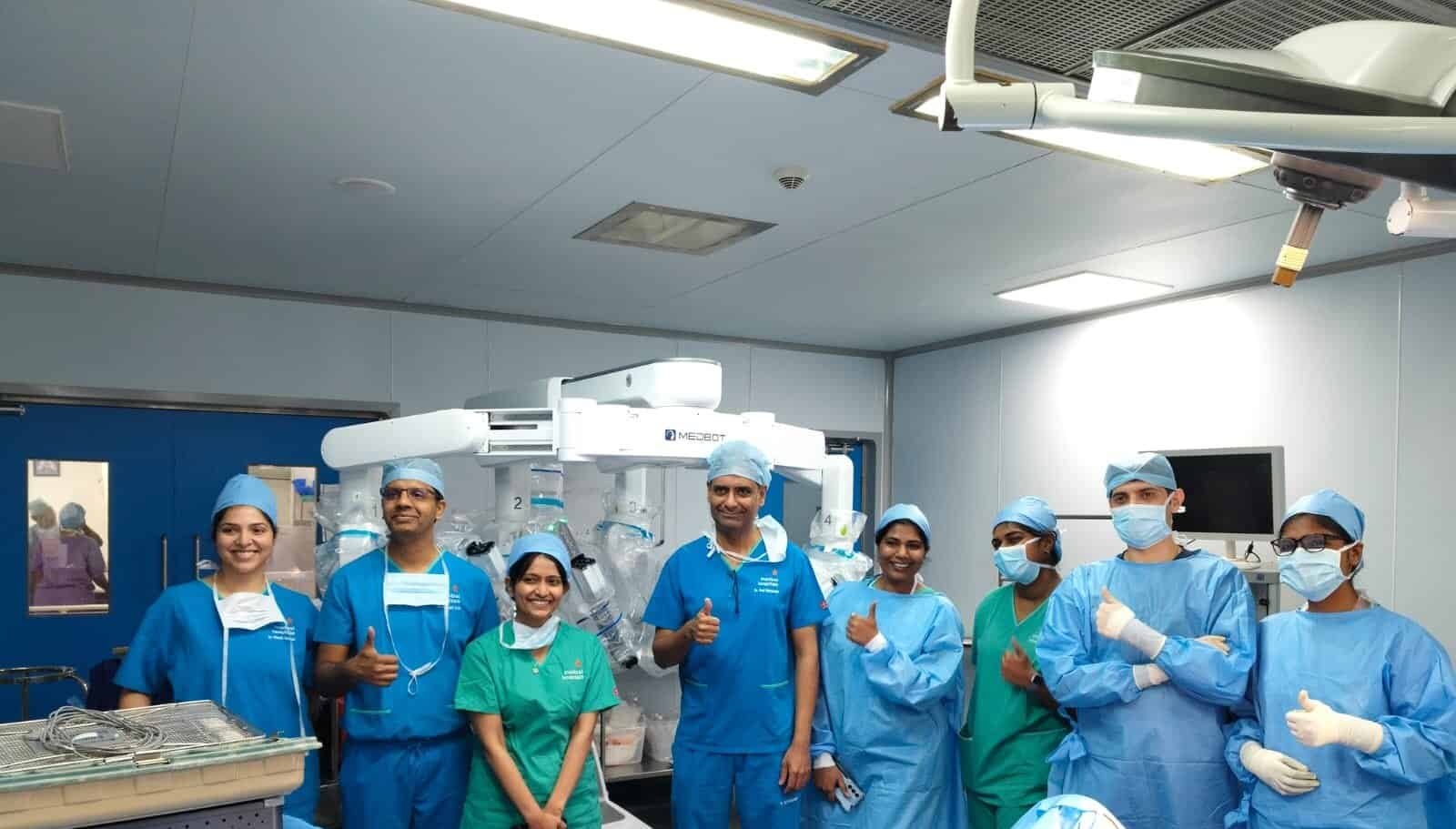
Robotic surgery may be considered for carefully selected tumors in less accessible areas, including some minor salivary gland tumors in the throat that can be approached through the mouth.
This is a limited, specialized role. Suitability depends on access, tumor size, proximity to major vessels, and whether adequate margins can be achieved. A robotic approach does not automatically improve cancer outcomes or suit routine parotid surgery.
Laparoscopic surgery
Conventional laparoscopic surgery is primarily used within the abdomen and is not a routine treatment for salivary gland tumors. Selected endoscopic or remote-access neck techniques are separate approaches and require careful assessment.
The Robotic Cancer Surgery, Laparoscopic Cancer Surgery, Open Cancer Surgery, and Minimally Invasive Cancer Surgery pages explain these methods more broadly. For your tumor, I will explain the specific reason for the recommended approach.

We review the planned operation, consent, anesthesia assessment, and medications. Please disclose blood thinners, diabetes medicines, supplements, and previous anesthesia problems. Do not stop prescribed medicines without instructions.
I also discuss the expected incision, possible drain, eating plan, and any likely need for reconstruction.
Hospital stay and early recovery
The length of stay varies. A limited operation may require a shorter admission than surgery involving lymph nodes or reconstruction. Discharge depends on pain control, eating and drinking, wound condition, and any additional monitoring needs.
A temporary drain may collect fluid from the surgical area. You and your caregiver will receive instructions if it remains in place after discharge.
Risks and functional recovery
Possible effects include facial weakness, numbness around the ear, wound problems, saliva leakage or collection, and changes in appearance. Sweating over the cheek while eating, called Frey syndrome, can develop after parotid surgery. Some effects improve with time; others need treatment.
Follow-up
We review healing and discuss the final pathology report, including margins, tumor grade, and lymph nodes. This determines whether further treatment is advisable. Some salivary gland cancers require prolonged surveillance.
The Recovery After Cancer Surgery page provides additional preparation. Seek urgent help for breathing difficulty or rapidly increasing neck swelling, and contact the team promptly for fever, worsening wound redness, or difficulty closing an eye.

I understand that treatment expenses are an important concern. The cost of salivary gland tumors surgery in Bangalore varies because removing a localized benign tumor differs substantially from treating cancer that involves lymph nodes, nerves, or surrounding tissues.
The estimate may depend on:
Robotic or specialized access techniques should be considered only when clinically appropriate. Conventional laparoscopy is not a routine option for these tumors.
Ask for an itemized hospital estimate after the proposed treatment is clear. Also clarify whether follow-up visits, rehabilitation, and any later radiation or drug treatment are included.
If you have insurance, confirm authorization requirements, exclusions, room limits, and potential out-of-pocket expenses with the hospital insurance team.

I currently consult at:
These centers provide access to comprehensive cancer care within a well-equipped hospital environment, supporting multidisciplinary treatment, investigations, and post-operative care when required.
Consultation timings and appointment details can be arranged through phone or WhatsApp for convenience.

This page has been written and medically reviewed under the guidance of Dr. Suraj Manjunath, Senior Surgical Oncologist at Apollo Hospitals, Bannerghatta Road, Bangalore.
The information has been reviewed for medical accuracy, patient clarity, and relevance to cancer surgery decision-making. Cancer treatment is always personalized and depends on factors such as the type of cancer, stage or spread of disease, overall health, co-morbidities, test results, and treatment goals.
The information is meant for patient education and should not replace an in-person consultation, diagnosis or personalized treatment plan.
Consultation Locations: Apollo Hospitals, Bannerghatta Road & Sarjapur Road, Bangalore.
Last reviewed: September 2026
