Dr Suraj Manjunath Website Logo

Desmoid Tumor Surgeon in Bangalore

Dr Suraj Manjunath is a senior Surgical Oncologist at Apollo Hospitals who provides individualized Desmoid Tumor treatment in Bangalore. Treatment may involve active surveillance, surgery, medication, or radiation therapy, depending on the tumor’s location, growth, symptoms, and involvement of nearby structures. When surgery is appropriate, the goal is to control the tumor while preserving organs, movement, function, and quality of life.

Dr Suraj Manjunath 5 650 X

What Is a Desmoid Tumor?

A non-metastatic tumor that develops from connective tissue.
What is a Desmoid Tumor

A desmoid tumor—also known as desmoid-type fibromatosis—is a rare growth that develops from fibroblasts. These are cells that form the connective tissue supporting muscles, ligaments, organs, and other structures in the body.

Desmoid tumors can occur in different locations:

  • Abdominal wall: Often develops within the muscles of the abdomen and may sometimes appear during or after pregnancy or previous abdominal surgery.
  • Inside the abdomen: May arise in the tissue supporting the intestines, known as the mesentery, or close to abdominal organs.
  • Outside the abdomen: Can develop in the shoulder, chest wall, back, arms, legs, head, or neck.

These tumors do not spread through the bloodstream or lymphatic system to distant organs. However, they can grow into nearby structures and may return in the same area after treatment.

Some desmoid tumors occur without a known cause. Others may be associated with changes in a gene called CTNNB1. A smaller number are linked to familial adenomatous polyposis, or FAP, an inherited condition caused by a change in the APC gene.

Early specialist evaluation is important because the location and behavior of the tumor—not simply its size—often determine whether treatment is required.

You may also find it helpful to explore the Soft Tissue and Bone Tumors for information about other tumors affecting connective tissue.

Arrange a specialist assessment to understand the location, behavior, and treatment implications of your desmoid tumor.

Your Trusted Desmoid Tumor Surgeon in Bangalore

Dr Suraj Manjunath Surgical Oncologist in Bangalore

Dr Suraj Manjunath

Senior Consultant - Surgical Oncologist

MBBS, MS (Gen Surgery), MCh (surgical oncology), Detroit Fellowship in Surgical Oncology and Minimally Invasive Surgery, SSO (Society of Surgical Oncology, USA) - Visiting Fellowship
Personal Note from Dr Suraj Manjunath

I understand that being told you have a tumor can be frightening. You may immediately worry about cancer, surgery, recurrence, and how the condition could affect your everyday life.

I am Dr. Suraj Manjunath, a Surgical Oncologist in Bangalore, associated with Apollo Hospitals, Bannerghatta Road and Apollo Hospitals, Sarjapur Road.

A desmoid tumor is unusual. It is not considered a cancer because it does not spread to distant parts of the body.

However, it can sometimes behave aggressively in the area where it develops. In other patients, it may remain stable for a long time or even become smaller without active treatment.

Therefore, my first recommendation is not automatically surgery. I begin by reviewing where the tumor is located, whether it is growing, the symptoms it is causing, and how treatment may affect nearby muscles, organs, nerves, and blood vessels.

As a Desmoid Tumor Surgeon in Bangalore, my role is to help you understand whether observation, surgery, medication, radiation therapy, or a combination of treatments is appropriate for your particular condition.

This page will help you understand the condition, diagnosis, treatment options, surgery, reconstruction, recovery, and the factors influencing the cost of treatment.

Dr Suraj Manjunath

+

Happy Patients

+

Cancer Surgeries

+

Yrs Experience

+

5* Google Reviews

Symptoms of a Desmoid Tumor

Symptoms depend on the tumor’s location, size, and relationship to nearby structures.
Symptoms of Desmoid Tumor

Some desmoid tumors are discovered during a scan performed for another reason. Others cause noticeable symptoms as they grow.

Possible symptoms include:

  • A firm lump or swelling that may or may not be painful
  • Gradual enlargement of a mass
  • Persistent pain, pressure, or discomfort
  • Reduced movement when the tumor involves a limb, shoulder, or joint
  • Weakness or difficulty using the affected muscle
  • Numbness or tingling if the tumor presses on a nerve
  • Abdominal pain, fullness, or swelling
  • Changes in bowel habits
  • Nausea or vomiting
  • Difficulty eating normally
  • Rarely, intestinal obstruction when an intra-abdominal tumor presses on or involves the bowel

Symptoms can vary considerably. A small tumor in a sensitive location may cause significant problems, while a larger tumor elsewhere may produce few symptoms.

A lump does not always mean a desmoid tumor. However, any persistent, enlarging, painful, or unexplained mass should be assessed before removal or treatment. An unplanned operation can make later treatment more difficult.

If you have an enlarging lump, persistent symptoms, or an existing diagnosis, consult a specialist before deciding on surgery.

Diagnosis & Evaluation of Desmoid Tumor

Accurate diagnosis is essential before deciding whether treatment is needed.
Diagnosis of Desmoid Tumor

Before recommending Desmoid Tumor Treatment in Bangalore, I review both the diagnosis and the extent of the tumor. Evaluation may include the following:

Clinical examination

I assess the location, size, firmness, mobility, and tenderness of the swelling. I also look for any effect on movement, nerve function, circulation, bowel function, or nearby organs.

MRI scan

MRI is particularly helpful for tumors in the abdominal wall, limbs, chest wall, shoulder, head, or neck. It shows the tumor’s relationship with muscles, nerves, blood vessels, and surrounding tissue.

CT scan

A CT scan may be more useful for tumors inside the abdomen. It can show whether the tumor is close to or involving the bowel, mesentery, urinary structures, or major blood vessels.

Biopsy

A core needle biopsy is usually performed before treatment. A small sample is taken from the tumor and examined under a microscope. Whenever possible, the biopsy should be planned by the team that may subsequently treat the tumor so that the biopsy path can be removed safely if surgery becomes necessary.

Pathology and molecular testing

The pathology report confirms whether the growth is a desmoid tumor and helps distinguish it from other soft tissue tumors. Testing for beta-catenin or CTNNB1 changes may support the diagnosis. Genetic evaluation for FAP may be advised in selected patients, particularly when the tumor is intra-abdominal, multifocal, or associated with a relevant family history.

Assessment of tumor extent

Desmoid tumors are not staged in the same way as cancers because they do not spread to distant organs. Instead, we assess their size, precise location, growth over time, symptoms, and involvement of nearby structures.

Fitness assessment

If surgery is being considered, blood tests, heart and lung evaluation, and an anesthesia assessment may be required. The exact tests depend on your age, health, and the expected complexity of the operation.

Have your scans and biopsy reviewed before beginning treatment or undergoing an operation.

Need a Second Opinion for Desmoid Tumor Surgery?

Get clarity on your diagnosis, treatment plan, and whether surgery is the right next step.

Desmoid Tumor Treatment in Bangalore

Treatment is selected according to tumor behavior, symptoms, location, and expected impact on daily life.
Desmoid tumor treatment may involve one or more of the following approaches:
medical team icon

Active surveillance

Observation with planned scans is often considered for a newly diagnosed, stable, or minimally symptomatic desmoid tumor. Surveillance is an active medical plan—not neglect. If the tumor grows or symptoms worsen, treatment can be reconsidered.
Surgery icon

Surgery

Surgery aims to remove the tumor while preserving important muscles, nerves, blood vessels, organs, and function. It may be particularly suitable for selected abdominal wall or superficial tumors when removal is expected to cause limited long-term disability.
targeted therapy

Targeted and systemic medicines

Medicines may be used when the tumor is growing, causing symptoms, cannot be removed safely, or has returned after previous treatment. Options may include targeted drugs such as tyrosine kinase inhibitors or other desmoid-directed treatments. The choice depends on availability, expected benefit, possible side effects, and the patient’s overall health.
chemotherapy

Chemotherapy

Chemotherapy is not required for most desmoid tumors. However, selected drug combinations may be used for rapidly progressing, severely symptomatic, or complicated tumors when a quicker response is needed.
radiation therapy

Radiation Therapy

Radiation therapy may be considered in carefully selected cases, such as an unresectable tumor causing significant problems or when further surgery would result in major disability. Its possible long-term effects must be weighed carefully, particularly in younger patients.
Noun immunotherapy 7248233 1F509A

Immunotherapy

Immunotherapy is not currently a routine treatment for desmoid tumors. If you have been advised immunotherapy, it is reasonable to discuss the evidence and treatment objective with a multidisciplinary team.

Whenever combined treatment is being considered, I prefer a multidisciplinary tumor board discussion. Complex cases may be discussed with medical oncologists, radiation oncologists, radiologists, pathologists, genetic specialists, plastic or reconstructive surgeons, and other specialists. This helps us choose treatment based on the complete clinical picture rather than the scan alone.
Request an individualized treatment plan based on the behavior and location of your tumor.

Surgical Options for Desmoid Tumor

The operation is planned around both tumor control and preservation of function.

The exact operation depends on where the tumor began and which structures it involves.

Abdominal wall desmoid tumor surgery

The tumor and the involved portion of the abdominal wall may need to be removed together. The resulting gap may be repaired using the patient’s own tissues, surgical mesh, or reconstructive techniques. A plastic or reconstructive surgeon may assist when a larger repair is required.

Intra-abdominal desmoid tumor surgery

A tumor inside the abdomen may involve the mesentery, bowel, or nearby structures. Surgery may require removal of a segment of involved bowel followed by reconnection. However, some intra-abdominal tumors are closely attached to important blood vessels or multiple bowel loops. Surgery in such cases may carry considerable risk, and nonsurgical treatment may be safer.

Extra-abdominal desmoid tumor surgery

For tumors involving the limbs, shoulder, chest wall, back, head, or neck, the goal is to remove the tumor while preserving movement, strength, nerve function, circulation, and appearance as far as safely possible.

Surgical margins

A margin is the rim of tissue around the removed tumor. Although obtaining a clear margin may be desirable, it should not come at the cost of unnecessary disability or removal of a critical structure. The balance between margins and function is discussed individually.

Lymph node removal

Routine lymph node removal is generally not required because desmoid tumors do not usually spread through the lymphatic system.

Even after successful surgery, a desmoid tumor can return in the same area. This is why thoughtful surgical planning and continued follow-up are important.

Meet Dr. Suraj to understand the proposed operation, reconstruction needs, expected benefits, and possible risks.

Surgical Approach for Desmoid Tumor

The safest and most effective approach is more important than the size of the incision.
Open Cancer Surgery

Patients often ask whether Desmoid Tumor Surgery in Bangalore can be performed using robotic or laparoscopic techniques. The answer depends mainly on the tumor’s location, size, and relationship to nearby structures.

Robotic surgery

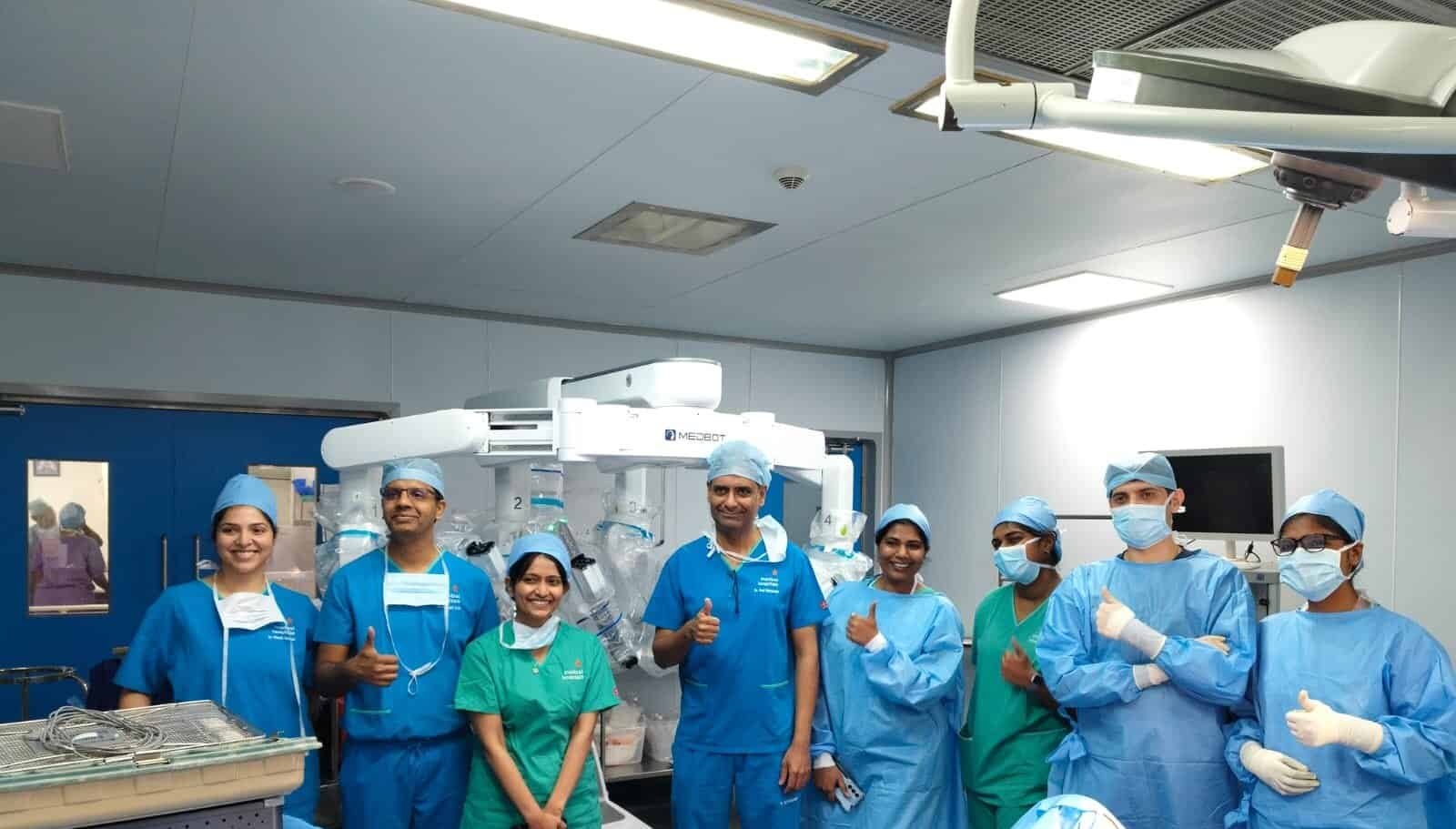
Robotic surgery may be considered for selected tumors inside the abdomen when the tumor can be approached safely and removed without compromising control. The robotic system provides magnified vision and precise instrument movement, but it is not appropriate for every desmoid tumor.

You can read more about Robotic Cancer Surgery and how patients are selected for this approach.

Laparoscopic surgery

Laparoscopic surgery uses small incisions and a camera to perform an operation inside the abdomen. It may be possible for carefully selected, well-positioned tumors. Explore Laparoscopic Cancer Surgery for a simple explanation of this technique.

Open surgery

Open surgery may be necessary for large tumors, abdominal wall tumors requiring reconstruction, recurrent tumors, or tumors involving several organs or major blood vessels. An open operation gives the surgeon direct access to complex anatomy and may sometimes provide the safest route. More information is available under Open Cancer Surgery.

Ask which surgical approach is suitable for your tumor and why it is being recommended.

What to Expect Before and After Desmoid Tumor Surgery

Clear preparation and follow-up can reduce uncertainty for patients and families.

Before surgery

I will review your scans, biopsy slides or report, medical history, current medicines, and general health. Additional imaging may be advised if the available scans are old or do not clearly show the tumor’s relationship with surrounding structures.

You will meet the anesthesia team and, when needed, other specialists involved in the operation. We will discuss:

  • The planned procedure
  • Structures that may need to be removed or repaired
  • Whether mesh or reconstruction may be required
  • Important risks and possible complications
  • Expected hospital stay
  • Pain control, nutrition, and mobility after surgery
  • The possibility of recurrence and the need for follow-up

Hospital stay

The length of stay varies. A smaller superficial operation may require a relatively short admission. Major abdominal surgery or abdominal wall reconstruction may require a longer stay.

After surgery, the team will monitor pain, wound healing, bowel function, nutrition, and mobility. ICU care is not required for every patient but may be planned for complex operations or patients with significant medical conditions.

Recovery at home

Recovery depends on the location and extent of surgery. Patients may initially need restrictions on lifting, strenuous exercise, or movements that place pressure on the operated area. Physiotherapy may be recommended when a limb, shoulder, abdominal wall, or major muscle group is involved.

The Recovery After Cancer Surgery resource can help patients and caregivers prepare for the early recovery period.

Final pathology report

The removed tissue is examined by a pathologist. During follow-up, I will explain whether the diagnosis has been confirmed, the status of the margins, and what these findings mean for further treatment or surveillance.

Long-term follow-up

Regular clinical reviews and MRI or CT scans may be advised because desmoid tumors can recur locally. The frequency of follow-up is individualized according to the tumor’s site, treatment, symptoms, and risk of recurrence.

Speak with the surgical team about preparation, hospital stay, recovery, and the support you may need at home.

Cost of Desmoid Tumor Surgery in Bangalore

The cost can be estimated responsibly only after reviewing the tumor and the proposed operation.
Senior Indian Lady

It is understandable that patients and families want to know the likely expense before planning treatment. However, there is no single fixed Cost of Desmoid Tumor Surgery in Bangalore because these tumors can range from a small abdominal wall mass to a complex tumor involving the bowel, muscles, nerves, or blood vessels.

The overall cost may depend on:

  • The location and size of the tumor
  • Whether it is a first-time or recurrent tumor
  • The organs or tissues involved
  • The type and duration of surgery
  • Whether robotic, laparoscopic, or open surgery is used
  • The need for mesh or abdominal wall reconstruction
  • The involvement of additional surgical specialists
  • Hospital room category
  • Duration of hospital stay
  • ICU care, if required
  • Medicines, consumables, and pathology testing
  • Preoperative investigations
  • Treatment of any unexpected complication
  • Insurance coverage or cashless authorization

After examining you and reviewing your scans, the hospital team can provide a more meaningful estimate based on the actual treatment plan. Patients with health insurance should check coverage, exclusions, room-rent limits, waiting periods, and preauthorization requirements before admission.

Schedule a consultation and treatment-plan review to obtain a case-specific hospital estimate.

Book A Consultation With Dr Suraj in Bangalore

Convenient access to specialist cancer surgery care at established hospital centres.
Dr Suraj Manjunath Website Consulting in his cabin

I currently consult at:

  • Apollo Hospitals, Bannerghatta Road, Bangalore
    Address: Apollo Hospitals, Opposite IIM, 154/11, Bannerghatta Rd, Krishnaraju Layout, Amalodbhavi Nagar, Panduranga Nagar, Bengaluru, Karnataka 560076

  • Apollo Hospitals, Sarjapur Road, Bangalore 
    Address: Apollo Hospitals, Sarjapur - Marathahalli Rd, Opp. Decathlon, Carmelaram, Ambedkar Nagar, Chikkabellandur, Mullur, Karnataka 560035)

These centers provide access to comprehensive cancer care within a well-equipped hospital environment, supporting multidisciplinary treatment, investigations, and post-operative care when required.

Consultation timings and appointment details can be arranged through phone or WhatsApp for convenience.

You can click the buttons below to call or WhatsApp the appointment desk to book your visit.
Click the button below to Call.
Click the button below to Whatsapp

Written & Reviewed by Dr. Suraj Manjunath

This page is reviewed for medical accuracy and patient education.
Dr Suraj Manjunath Surgical Oncologist in Bangalore

Dr. Suraj Manjunath

This page has been written and medically reviewed under the guidance of Dr. Suraj Manjunath, Senior Surgical Oncologist at Apollo Hospitals, Bannerghatta Road, Bangalore.

The information has been reviewed for medical accuracy, patient clarity, and relevance to cancer surgery decision-making. Cancer treatment is always personalized and depends on factors such as the type of cancer, stage or spread of disease, overall health, co-morbidities, test results, and treatment goals.

The information is meant for patient education and should not replace an in-person consultation, diagnosis or personalized treatment plan.

Consultation Locations: Apollo Hospitals, Bannerghatta Road & Sarjapur Road, Bangalore.
Last reviewed: September 2026

FAQs About Desmoid Tumor Treatment & Surgery

Answers to common questions patients and families ask when exploring Desmoid Tumor treatment and surgery.

A desmoid tumor is not considered cancer because it does not spread to distant organs. However, it can grow into nearby tissues and sometimes cause serious local problems. It can also return after treatment, so specialist assessment and follow-up are important.

No. A stable tumor that is not causing significant symptoms may be monitored with regular scans. Surgery is considered when the tumor is growing, causing problems, threatening an important structure, or can be removed without unacceptable loss of function.

Yes. Some desmoid tumors remain stable or become smaller during active surveillance. Their behavior can be unpredictable, which is why treatment decisions should be based on changes seen over time rather than the diagnosis alone.

Robotic surgery may be possible for selected tumors inside the abdomen. It is not suitable for every patient. Large, recurrent, abdominal wall, or extensively involving tumors may require open surgery.

Yes. A desmoid tumor can recur in the same area even after it has been removed. The likelihood varies with the location, tumor biology, previous treatment, and other factors. Regular follow-up is therefore recommended.

Recovery depends on the operation. A limited superficial procedure may allow an earlier return to routine activity, while major abdominal surgery or reconstruction can require several weeks or longer. Your surgeon will provide guidance based on the exact procedure.

Cost is affected by the extent of surgery, surgical approach, reconstruction requirements, hospital stay, ICU need, investigations, pathology, consumables, and the management of other medical conditions.

Yes. A second opinion can be particularly valuable for a desmoid tumor because immediate surgery is not always necessary. Bring your biopsy report, pathology slides or blocks if available, MRI or CT images, previous scan reports, operative notes, and a list of current medicines.

Make a Well-Informed Decision About Desmoid Tumor Treatment

The right plan should control the tumor while protecting your health, function, and quality of life.
If you or a family member has been diagnosed with a desmoid tumor, you do not need to rush into an operation without understanding all the available options.

My first step is to confirm the diagnosis, assess how the tumor is behaving, and understand what it is affecting. I will then explain whether active surveillance, surgery, medication, radiation therapy, or multidisciplinary treatment should be considered.

If surgery is appropriate, we will discuss its purpose, the structures involved, possible reconstruction, expected recovery, and the risk of recurrence. If surgery is not the best first option, I will explain why and help guide you toward the appropriate specialist care.

You can consult me for Desmoid Tumor Treatment in Bangalore, surgical planning, or a second opinion at Apollo Hospitals, Bannerghatta Road or Sarjapur Road.
Contact / Book Appointment with Dr. Suraj Manjunath for Desmoid Tumor Surgery in Bangalore or a surgical oncology second opinion.
Disclaimer Statement : The information published on this website is generic in nature and the results vary from case to case. The content of this website is not meant to replace an in-person consultation. Please follow the advice of your doctor via in-person consultation. This website will not assume any legal responsibility for the patient’s medical condition.
© 2026 Dr Suraj Manjunath. All Right Reserved.
Privacy Policy Terms Of Use

Book an Appointment with Dr. Suraj Manjunath

Dr. Suraj Manjunath provides consultations at Apollo Hospitals, Bannerghatta Road, Bangalore.
You can click the buttons below to call or WhatsApp the appointment desk to book your visit.
Click the button below to Call.
Click the button bellow to Whatsapp
Apollo Hospital
Bannerghatta Road
Address: IIM, 154/11, Bannerghatta Rd, opposite Krishnaraju Layout, Krishnaraju Layout, Amalodbhavi Naga, Panduranga Nagar, Bengaluru, Karnataka 560076
Call or WhatsApp the appointment desk. The team will help you choose the most suitable time based on availability and convenience.
Call Now Button