
Dr Suraj Manjunath is a senior Surgical Oncologist providing Abdominal Wall Tumor treatment in Bangalore at Apollo Hospitals. Treatment is planned according to the tumor type, size, location, and involvement of nearby tissues. Surgery may include complete tumor removal with safe margins and abdominal wall reconstruction using mesh or tissue flaps when required, followed by coordinated multidisciplinary care.


The abdominal wall is made up of several layers. These include the skin, fatty tissue, connective tissue called fascia, muscles, and the inner lining that separates the abdominal wall from the organs inside the abdomen.
A tumor can arise from any of these tissues.
Common categories include:
Not every abdominal wall swelling is a tumor. Hernias, collections of blood after an injury, infections, and scar-related changes can sometimes appear similar. This is why a proper clinical examination and appropriate imaging are necessary.

I understand that finding a lump in the abdomen—or being told that a scan shows a tumor—can create considerable anxiety.
Patients and families often want immediate answers: Is it cancer? Does it need surgery? Can it spread? Will the abdominal wall need to be reconstructed?
These questions are important, but they cannot be answered from the scan alone in every case.
An abdominal wall tumor can be benign, meaning noncancerous; locally aggressive, meaning it can grow into nearby tissues without spreading to distant organs; or malignant, meaning cancerous. The treatment differs significantly for each type.
I am Dr. Suraj Manjunath, a Surgical Oncologist in Bangalore, associated with Apollo Hospitals, Bannerghatta Road and Apollo Hospitals, Sarjapur Road.
My first responsibility as an Abdominal Wall Tumor Surgeon in Bangalore is to establish the correct diagnosis before recommending an operation.
I review the scan, biopsy report, pathology findings, previous treatment records, and your general health. If necessary, the case is discussed with radiologists, pathologists, medical oncologists, radiation oncologists, and reconstructive surgeons.
My goal is not simply to remove a lump. It is to plan treatment that offers appropriate tumor clearance while protecting abdominal wall strength, movement, and quality of life.
This page will help you understand the condition, diagnosis, treatment options, surgery, reconstruction, recovery, and the factors influencing the cost of treatment.

+

+

+

+

The symptoms depend on the tumor’s size, location, depth, and rate of growth.
Possible signs include:
Many small tumors do not cause pain. The absence of pain does not confirm that a lump is harmless.
Please seek specialist evaluation if the swelling is increasing in size, feels deep or fixed, has returned after previous surgery, or has been reported as suspicious on imaging.

Treatment planning generally begins with a detailed history and physical examination. I will ask when you first noticed the lump, whether it is growing, whether you have pain, and whether you have had surgery or treatment in that area before.
The evaluation may include the following:
An ultrasound can help determine whether a superficial lump is solid or fluid-filled. It may be useful as an initial test, but deeper or suspicious tumors usually require more detailed imaging.
A contrast-enhanced CT scan can show the size of the tumor, the abdominal wall layers involved, and its relationship with organs inside the abdomen. It also helps in planning reconstruction.
MRI provides detailed information about muscles, fascia, nerves, and soft tissue planes. It can be particularly helpful when the tumor is deep, large, or close to important structures.
A biopsy removes a small sample of tissue for examination. For many suspicious soft tissue tumors, an image-guided core needle biopsy is preferred.
The biopsy route should be planned carefully because the biopsy track may need to be removed during definitive surgery. A small superficial lesion may occasionally be removed completely for diagnosis, but this decision should be made only after appropriate evaluation.
The tissue is examined under a microscope to determine the exact tumor type and grade. Some tumors require special laboratory tests, including immunohistochemistry or molecular testing, to confirm the diagnosis.
If the biopsy shows a malignant tumor, additional scans may be advised to determine whether it has spread. Soft tissue sarcomas more commonly spread through the bloodstream than through lymph nodes, although the pattern depends on the tumor subtype.
Before major surgery, blood tests, heart and lung assessment, nutritional evaluation, and an anesthesia review may be required. This allows us to reduce avoidable risk and prepare you properly.


Whenever combined treatment is being considered, I prefer a multidisciplinary tumor board discussion. This allows the sequence of surgery, radiation, and systemic treatment to be planned rather than decided in isolation.
Learn how a Tumor Board helps specialists coordinate complex cancer treatment decisions.
The extent of surgery varies considerably. A small superficial tumor may require a relatively limited operation. A larger tumor involving several muscle layers may require removal of a substantial section of the abdominal wall and complex reconstruction.
Possible surgical procedures include:
The tumor is removed together with a planned border of surrounding tissue. This border is called the surgical margin. The purpose is to reduce the possibility of microscopic tumor cells being left behind.
After surgery, the pathologist examines the edges of the removed specimen. A negative or clear margin means that tumor cells are not seen at the edge. A positive margin means that tumor cells reach the edge and further treatment may need to be discussed.
If the tumor involves skin, fat, fascia, muscle, and the inner lining, some or all of these layers may need to be removed together. This is called an en bloc resection, meaning the involved tissues are removed in one planned specimen.
If the tumor has grown into an adjacent organ or structure, removing only the visible lump may not provide adequate clearance. A limited portion of the involved structure may occasionally need to be removed with the tumor.
The aim is to preserve organs and healthy tissues whenever it is oncologically safe—not at the cost of leaving behind known disease.
After the tumor is removed, the remaining defect must be closed securely. Reconstruction may involve:
For large or complex defects, I may plan the operation jointly with a plastic or reconstructive surgeon. Reconstruction is not merely cosmetic. It helps protect the organs, restore abdominal support, reduce weakness, and allow better movement.
Routine lymph node removal is not required for most soft tissue sarcomas because lymph node spread is uncommon. Suspicious nodes may be sampled or removed when imaging, examination, or the specific tumor subtype indicates a meaningful risk.

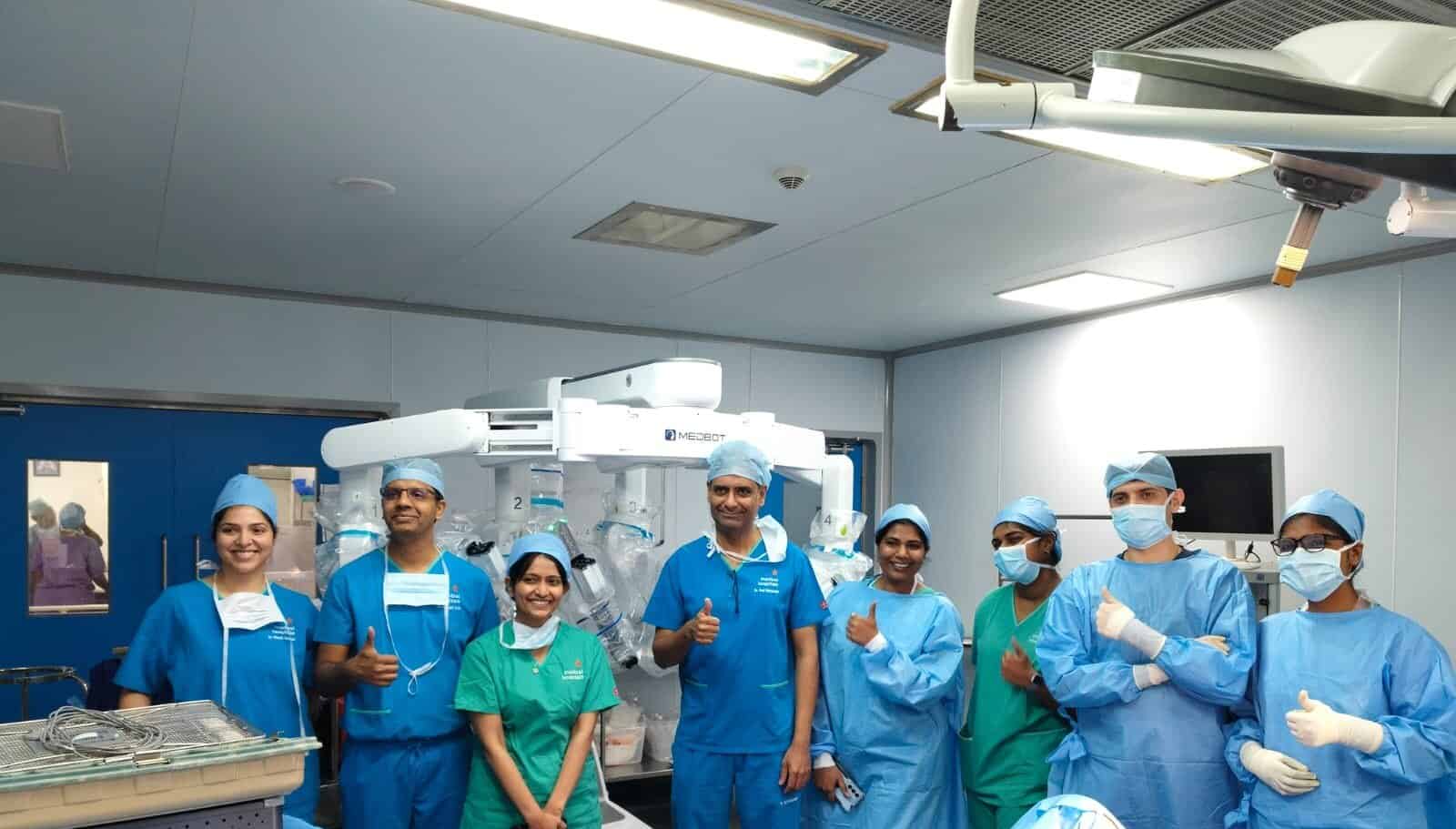
Patients often ask whether Abdominal Wall Tumor Surgery in Bangalore can be performed robotically or laparoscopically.
For many primary abdominal wall tumors, open surgery is the most appropriate approach. It gives the surgeon direct access to the tumor, surrounding tissues, skin, muscles, and reconstruction area. This can be especially important when a wide margin or full-thickness abdominal wall removal is required.
Open surgery may be advised when:
Laparoscopic surgery uses small incisions and a camera. It may have a role in carefully selected tumors that project mainly toward the inside of the abdomen or when an associated internal procedure is required.
Robotic surgery provides magnified vision and precise instrument movement. It may be considered in selected cases involving the inner aspect of the abdominal wall or when another procedure inside the abdomen must be performed.
However, robotic or laparoscopic surgery should not be used if it compromises tumor handling, surgical margins, or reconstruction. A smaller incision is valuable only when cancer safety remains uncompromised.
I select between Robotic Cancer Surgery, Laparoscopic Cancer Surgery, Minimally Invasive Cancer Surgery, and Open Cancer Surgery based on what provides the safest and most complete treatment for that particular patient.

Before the operation, I will explain:
You may undergo blood tests, an anesthesia assessment, nutritional evaluation, and heart or lung tests depending on your age, health, and the complexity of surgery.
If you smoke, stopping before surgery can improve wound healing. Diabetes, anemia, nutritional deficiencies, and infections should be addressed wherever possible.
Pain relief, wound monitoring, breathing exercises, and early movement are important. Some patients may have surgical drains to remove fluid from the operated area.
An abdominal binder may occasionally be advised for support. Its use depends on the type of reconstruction.
A small excision may require only a short hospital stay. A major resection with mesh or flap reconstruction may require several days in the hospital and closer monitoring.
Walking usually begins early, but lifting, strenuous exercise, and abdominal strain may be restricted for a period. The duration depends on the size of the operation and the reconstruction performed.
Recovery is not identical for every patient. I will provide guidance based on your surgery, occupation, home support, and general health.
The removed specimen is examined in detail after surgery. The final report confirms:
Once the report is available, I discuss it with the patient and family. We then decide whether observation, radiation, systemic treatment, or another intervention is required.
Regular follow-up may include clinical examinations and scans because some abdominal wall tumors can return locally even after treatment.

It is natural for patients and families to ask about treatment expenses. However, there is no single fixed price for every abdominal wall tumor operation.
The Cost of Abdominal Wall Tumor Surgery in Bangalore may depend on:
A small superficial tumor removal and a major full-thickness resection with complex reconstruction are very different procedures. Giving a general figure without reviewing the reports may therefore be misleading.
After examining you and reviewing the scan and biopsy, the likely procedure can be outlined. The hospital team can then provide a more relevant estimate and assist with insurance or authorization requirements.

I currently consult at:
These centers provide access to comprehensive cancer care within a well-equipped hospital environment, supporting multidisciplinary treatment, investigations, and post-operative care when required.
Consultation timings and appointment details can be arranged through phone or WhatsApp for convenience.

This page has been written and medically reviewed under the guidance of Dr. Suraj Manjunath, Senior Surgical Oncologist at Apollo Hospitals, Bannerghatta Road, Bangalore.
The information has been reviewed for medical accuracy, patient clarity, and relevance to cancer surgery decision-making. Cancer treatment is always personalized and depends on factors such as the type of cancer, stage or spread of disease, overall health, co-morbidities, test results, and treatment goals.
The information is meant for patient education and should not replace an in-person consultation, diagnosis or personalized treatment plan.
Consultation Locations: Apollo Hospitals, Bannerghatta Road & Sarjapur Road, Bangalore.
Last reviewed: September 2026
