
Dr Suraj Manjunath is a senior Surgical Oncologist providing Cytoreductive Surgery (CRS) and HIPEC cancer treatment in Bangalore at Apollo Hospitals. The treatment combines surgery to remove visible cancer from the abdomen with heated chemotherapy delivered directly into the abdominal cavity. It may benefit carefully selected patients with certain cancers that have spread to the abdominal lining.


CRS and HIPEC are related, but they are not the same procedure.
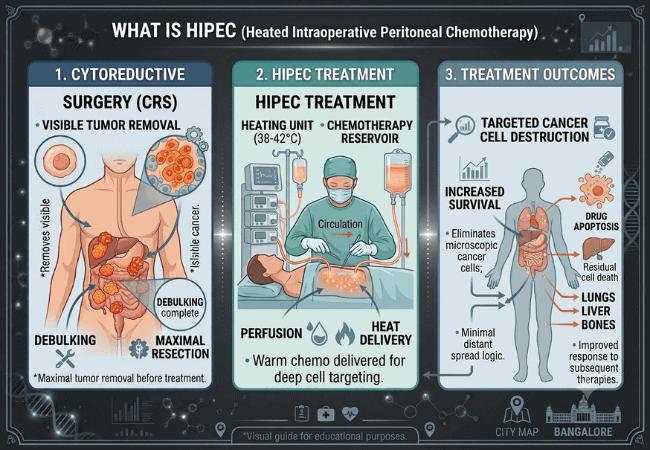
Cytoreductive Surgery, commonly called CRS, is an operation performed to remove visible cancer from the abdominal cavity.
Cancer may sometimes spread over the peritoneum—a thin membrane that lines the inner surface of the abdomen and covers many abdominal organs. Instead of forming one isolated lump, the cancer may appear as multiple deposits across these surfaces.
During CRS, I carefully examine the abdomen and remove as much visible disease as safely possible. Depending on where the cancer is located, this may involve removing affected portions of the peritoneal lining. This is called a peritonectomy procedure.
In some patients, parts of affected organs may also need to be removed. These can include portions of the bowel, appendix, gallbladder, spleen, omentum—the fatty layer covering the abdominal organs—or, in selected cases, reproductive organs.
The exact operation is different for every patient.
Once the visible cancer has been removed, heated chemotherapy may be circulated through the abdominal cavity. This is called HIPEC.
“Hyperthermic” means heated, “intraperitoneal” means inside the abdominal cavity, and “chemotherapy” refers to medicines used to destroy cancer cells.
The chemotherapy solution is warmed to a controlled temperature and circulated through the abdomen for a planned period. The aim is to expose the abdominal surfaces directly to chemotherapy and treat microscopic cancer cells that may remain after surgery.
The drug, temperature and duration are selected according to the cancer type and the treatment protocol being followed.
HIPEC is given during the operation while the patient remains under anesthesia. It is different from intravenous chemotherapy, which travels through the bloodstream and treats cancer throughout the body.

If you or a family member has been told that cancer has spread to the lining of the abdomen, you may hear terms such as peritoneal disease, cytoreductive surgery, peritonectomy or HIPEC.
These words can sound frightening, especially when you are already trying to understand a complex cancer diagnosis.
I am Dr. Suraj Manjunath, a Surgical Oncologist in Bangalore, associated with Apollo Hospitals, Bannerghatta Road and Apollo Hospitals, Sarjapur Road.
My first responsibility is to determine whether this treatment is likely to provide meaningful benefit in your particular situation.
In simple terms, Cytoreductive Surgery removes all visible cancer that can be safely removed from the abdominal cavity. HIPEC—Hyperthermic Intraperitoneal Chemotherapy—is heated chemotherapy circulated inside the abdomen during the same operation to treat cancer cells that may remain but cannot be seen with the naked eye.
However, the presence of cancer within the abdomen does not automatically mean that CRS and HIPEC is required or possible. The decision depends on where the cancer started, how far it has spread, whether it can be removed safely and whether the patient is physically fit for major surgery.
This page will help you understand what CRS and HIPEC surgery in Bangalore involves, the cancers for which it may be considered, its possible benefits and risks, and how we assess whether it is appropriate.

+

+

+

+

CRS and HIPEC is mainly considered when cancer is present on the peritoneal surfaces within the abdomen.
It may be evaluated in carefully selected patients with:
Some appendix tumors produce a jelly-like material that gradually collects within the abdomen. This condition is known as pseudomyxoma peritonei.
Cytoreductive surgery combined with HIPEC is an established treatment approach for many suitable patients with this condition. The operation may involve removing the mucus, visible tumors and affected peritoneal surfaces.
Colon or rectal cancer can sometimes spread to the lining of the abdomen.
For selected patients whose disease is largely confined to the peritoneal cavity and can be substantially or completely removed, cytoreductive surgery may be considered along with systemic chemotherapy. Whether HIPEC should be added is more complex because recommendations and evidence vary according to the clinical situation and HIPEC protocol.
I discuss this distinction clearly rather than assuming that every patient undergoing cytoreduction for colorectal cancer also needs HIPEC.
Cytoreductive surgery is an important part of treatment for many patients with advanced ovarian cancer.
HIPEC may be considered in selected patients, particularly in certain interval-surgery settings after initial chemotherapy. It is not routinely appropriate at every stage of ovarian cancer treatment.
Malignant peritoneal mesothelioma is a rare cancer arising from the abdominal lining. CRS with HIPEC may be an option for selected patients when the disease can be adequately removed and the patient is fit for treatment.
HIPEC has also been studied in cancers such as stomach cancer and some other rare abdominal tumors. Its role in these conditions is more limited and may depend on the stage, biology of the disease, institutional protocol and available clinical evidence.
A recommendation should therefore be based on the exact diagnosis—not simply on the presence of abdominal spread.

CRS and HIPEC is a major operation. Careful selection helps avoid an extensive procedure when the expected benefit is limited.
The assessment commonly includes:
We also estimate the amount and distribution of disease within the abdomen. This may be described using a Peritoneal Cancer Index, or PCI. The abdomen is divided into regions, and the amount of disease in each region is recorded.
The PCI is helpful, but it is not the only deciding factor. The cancer type, involvement of the small bowel or vital structures, disease outside the abdomen and the likelihood of removing the visible disease are equally important.
In some cases, imaging cannot show the full extent of the cancer. A staging laparoscopy—a keyhole examination of the abdominal cavity—may be advised before committing to a major operation.
For an appropriately selected patient, CRS and HIPEC may:
The outcome is strongly influenced by the biology of the cancer and how completely the visible disease can be removed.
CRS and HIPEC cannot guarantee that cancer will not return. It also cannot reliably treat cancer that has spread widely through the bloodstream to distant organs.
The procedure may not be appropriate when:

CRS with HIPEC is more complex than a standard abdominal operation.
The surgeon must identify disease across multiple abdominal regions, decide what can be removed safely and judge whether useful cytoreduction can be achieved. Several organs or peritoneal surfaces may need to be treated during the same operation.
Experience is important not only for performing the procedure but also for deciding when not to perform it.
The treatment requires:
If complete or near-complete cytoreduction is unlikely, starting a very extensive operation may not benefit the patient. This is why surgical judgment is just as important as technical ability.
When people search for the “best HIPEC surgeon in Bangalore,” I encourage them to look beyond a label. Ask how suitability is assessed, how often cases are discussed by a multidisciplinary team, what outcomes are realistically expected and what postoperative support is available.

Preparation may begin several weeks before the operation. We assess blood counts, nutrition, kidney and liver function, heart and lung health, medications and previous treatments.
Patients may be advised to improve protein intake, stop smoking, control diabetes, practice breathing exercises and remain physically active within safe limits. This preparation is sometimes called pre-habilitation.
You will also meet members of the anesthesia and surgical-care teams. We discuss the possibility of bowel resection, a temporary or permanent stoma, blood transfusion and intensive-care monitoring when relevant.
The operation is performed under general anesthesia.
Cytoreductive surgery comes first. All visible disease that can be safely removed is treated. HIPEC is given only after the required cytoreduction has been achieved and if it remains appropriate.
The duration varies considerably. CRS and HIPEC can take several hours because the amount and location of disease differ from patient to patient.
After surgery, some patients require monitoring in an intensive-care or high-dependency unit. Pain control, breathing exercises, blood-clot prevention, nutrition and early movement are important parts of recovery.
The bowel may take time to begin working normally. Fluids and food are introduced gradually. Drains, urinary catheters or feeding support may be required temporarily.
Many patients remain in hospital for approximately one to two weeks, but the stay may be shorter or considerably longer depending on the extent of surgery and any complications.
Tiredness, reduced appetite and changes in bowel habits are common during early recovery. Patients should gradually increase walking and activity while avoiding heavy lifting until cleared by the surgical team.
Recovery often takes several weeks and may extend beyond two to three months after an extensive operation. Follow-up includes wound review, final pathology discussion, nutritional assessment and planning of any further cancer treatment.

CRS and HIPEC is a high-complexity treatment and can cause significant complications.
Possible surgical risks include bleeding, infection, blood clots, chest infection, delayed bowel function, leakage from a bowel connection, abdominal collections, wound problems and the need for another procedure.
Depending on the organs treated, some patients may experience altered bowel habits, temporary difficulty eating, nutritional problems or the need for a stoma.
The chemotherapy used during HIPEC can occasionally affect the kidneys, blood-cell counts or other organs. The precise risks depend on the drug, dose, duration and the patient’s existing health.
A complication does not necessarily mean that something was done incorrectly. Even with meticulous surgery and careful monitoring, major operations place considerable stress on the body.
We reduce risk through proper patient selection, preoperative optimization, experienced anesthesia, careful surgical technique, infection and clot prevention, postoperative monitoring and structured recovery pathways.

It is understandable that patients and families want to know the cost of HIPEC surgery in India before making arrangements.
There is no single fixed price for Cytoreductive Surgery with HIPEC because the treatment can range from a relatively limited operation to extensive multiorgan surgery.
The overall cost may depend on:
After reviewing the reports and proposed surgery, the hospital team can provide a more meaningful estimate.
Cost is important, but it should not be assessed separately from suitability. An expensive and extensive procedure is not worthwhile if it is unlikely to help. The first step should therefore be a proper clinical evaluation.

I currently consult at:
These centers provide access to comprehensive cancer care within a well-equipped hospital environment, supporting multidisciplinary treatment, investigations, and post-operative care when required.
Consultation timings and appointment details can be arranged through phone or WhatsApp for convenience.

This page has been written and medically reviewed under the guidance of Dr. Suraj Manjunath, Senior Surgical Oncologist at Apollo Hospitals, Bannerghatta Road, Bangalore.
The information has been reviewed for medical accuracy, patient clarity, and relevance to cancer surgery decision-making. Cancer treatment is always personalized and depends on factors such as the type of cancer, stage or spread of disease, overall health, co-morbidities, test results, and treatment goals.
The information is meant for patient education and should not replace an in-person consultation, diagnosis or personalized treatment plan.
Consultation Locations: Apollo Hospitals, Bannerghatta Road & Sarjapur Road, Bangalore.
Last reviewed: September 2026
