
If you are searching for an expert ovarian cancer surgeon in Bangalore, Dr Suraj Manjunath provides highly specialized care at Apollo Hospitals. He delivers tailored, comprehensive ovarian cancer treatment in Bangalore focused on thorough tumor management and protecting your overall systemic health.


If you or a loved one has been diagnosed with ovarian cancer, it is natural to feel anxious and uncertain. You may be wondering whether surgery is needed, what treatment will involve, and how to make the right decision.
I am Dr. Suraj Manjunath, a Surgical Oncologist in Bangalore, associated with Apollo Hospitals, Bannerghatta Road and Apollo Hospitals, Sarjapur Road.
My Approach is simple. I look at the whole picture—your symptoms, the stage of disease, your general health, whether surgery can safely remove the disease, and how best to combine surgery with other treatments when needed.
As an Ovarian Cancer Surgeon in Bangalore, my role is to help you understand the situation clearly and guide you toward the safest and most appropriate treatment plan.
This page will help you understand ovarian cancer, when surgery is needed, what treatment may involve, what recovery is usually like, and what factors affect the cost of ovarian cancer surgery in Bangalore.

+

+

+

+

Ovarian cancer does not always present with dramatic symptoms. In fact, many women experience signs that can be mistaken for acidity, indigestion, bloating, or routine abdominal discomfort.
Common symptoms may include:
Symptoms can vary from person to person. Some women have mild symptoms for weeks or months. Others may first come to medical attention because of a scan showing a pelvic mass, or because fluid has collected inside the abdomen.
These symptoms do not always mean cancer. But if they are persistent, worsening, or associated with a known ovarian cyst, mass, or abnormal scan, proper consultation is important.

The treatment plan for ovarian cancer is based on a combination of clinical examination, imaging, laboratory tests, and tissue diagnosis when needed. The process often includes:
Ultrasound or scan findings:
Many patients are first found to have an ovarian mass on ultrasound. A CT scan is commonly used to assess the size of the tumor and whether there is spread inside the abdomen or elsewhere.
Blood tests:
Certain tumor markers, such as CA-125, may be checked. These tests can support the diagnosis, but they do not replace proper imaging and specialist judgment.
Biopsy or tissue diagnosis:
In some patients, a tissue sample is taken before treatment, especially if chemotherapy may be needed before surgery. In others, the diagnosis becomes fully confirmed after surgery when the specimen is examined by the pathologist.
Pathology:
Pathology tells us exactly what type of ovarian cancer is present. This is very important because treatment can differ depending on the tumor type and grade.
Staging:
Staging means understanding how far the cancer has spread. Has it remained limited to the ovary? Has it involved the lining of the abdomen, lymph nodes, or other organs? Staging helps determine the best sequence of treatment.
In simple terms, good treatment begins with good planning. I prefer that patients and families understand why each test is being done, rather than feeling rushed into treatment without clarity.


There is no single operation that suits every ovarian cancer patient.
In early-stage disease, surgery may involve removal of the affected ovary along with related structures and careful staging to check whether the cancer has spread. In many patients, the surgery includes removal of both ovaries, fallopian tubes, the uterus, nearby fatty tissue called the omentum, and sampling or removal of selected lymph nodes when required.
In advanced cases, the operation may involve cytoreductive surgery, where the goal is to remove as much visible disease as safely possible. This may involve surgery on tissues inside the abdomen where ovarian cancer commonly spreads.
Sometimes patients ask whether organ preservation is possible. In selected younger women with very early disease, fertility-preserving treatment may be considered carefully. But this is only possible in a limited group of patients and only when it is oncologically safe. The first priority is always proper cancer treatment.
Node-related procedures may also be part of staging or treatment in some situations. Whether lymph node assessment is needed depends on the type of cancer and what is found during evaluation and surgery.
I explain this carefully to every patient before surgery, because it is important that families understand not just the operation name, but the purpose behind each step.

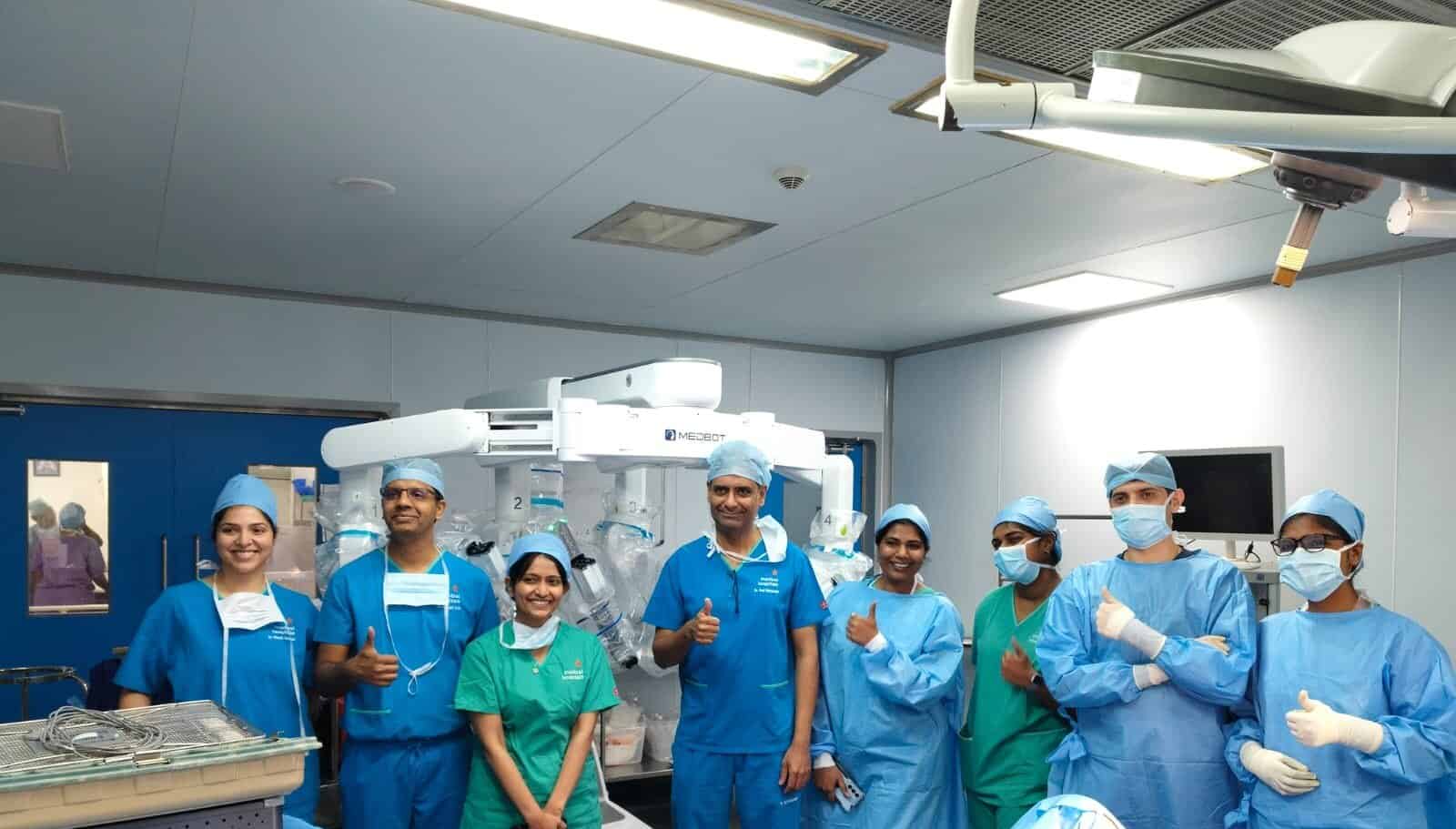
Many patients today ask specifically about robotic surgery or laparoscopic surgery. This is understandable. Smaller cuts, less pain, and quicker recovery are attractive advantages when they are appropriate.
In ovarian cancer, however, the choice of surgical approach must be made carefully.
Robotic surgery may be possible in selected patients, especially in carefully chosen situations where the disease appears limited and the procedure can be done safely and completely.
Laparoscopic surgery may be possible for certain evaluations, selected early-stage cases, or specific parts of diagnosis and staging.
Open surgery may still be necessary in many ovarian cancer patients, especially when the disease is extensive, when major abdominal clearance is needed, or when I need full access to remove all visible disease as safely as possible.
Many patients who need cytoreductive surgery for ovarian cancer may still require an open approach, especially when the disease is widespread within the abdomen.
As a surgical oncologist, I use judgment first and technique second. If a minimally invasive approach is appropriate, I consider it. If open surgery is the safer and more complete option, I explain that honestly.

Before surgery, I review your diagnosis, scan findings, biopsy or pathology details, and fitness for anesthesia. You may need blood tests, a heart check-up, and other evaluations depending on your age and health condition.
I also discuss the likely extent of surgery, possible risks, expected hospital stay, and whether additional treatment such as chemotherapy may be needed afterward.
After surgery, the first focus is recovery, pain control, early mobilization, and safe return of bowel function. The length of hospital stay depends on the complexity of the procedure and whether the surgery was minimally invasive or open.
Some patients recover more quickly after smaller procedures, while others need more time after major abdominal surgery. Fatigue for a few weeks is common. Nutrition, walking, breathing exercises, wound care, and follow-up all play an important role.
One of the most important steps after surgery is the final pathology discussion. This is when I explain exactly what the specimen showed, the postoperative stage (pathologic staging), and what the next treatment recommendation is.
Families are often anxious during this period. I make it a point to explain the findings clearly and help patients understand the next steps rather than leaving them with unanswered questions.
You may also find our Recovery After Cancer Surgery page helpful for a broader understanding of healing and follow-up.

Many patients and families understandably want to know the Cost of Ovarian Cancer Surgery in Bangalore. This is an important practical concern, and it should be discussed openly.
At the same time, it is not responsible to quote a single standard price for every ovarian cancer surgery, because the cost can vary significantly from one patient to another.
The cost usually depends on:
In some patients, surgery is only one part of the total treatment cost because chemotherapy, targeted therapy, or additional care may also be needed.

I currently consult at:
These centers provide access to comprehensive cancer care within a well-equipped hospital environment, supporting multidisciplinary treatment, investigations, and post-operative care when required.
Consultation timings and appointment details can be arranged through phone or WhatsApp for convenience.

This page has been written and medically reviewed under the guidance of Dr. Suraj Manjunath, Senior Surgical Oncologist at Apollo Hospitals, Bannerghatta Road, Bangalore.
The information has been reviewed for medical accuracy, patient clarity, and relevance to cancer surgery decision-making. Cancer treatment is always personalized and depends on factors such as the type of cancer, stage or spread of disease, overall health, co-morbidities, test results, and treatment goals.
The information is meant for patient education and should not replace an in-person consultation, diagnosis or personalized treatment plan.
Consultation Locations: Apollo Hospitals, Bannerghatta Road & Sarjapur Road, Bangalore.
Last reviewed: September 2026
