
Dr Suraj Manjunath, a Surgical Oncologist at Apollo Hospitals, provides evaluation and surgical care for patients with laryngeal (voice box) cancer. Laryngeal (voice box) Cancer treatment in Bangalore may involve endoscopic or open surgery, radiation, chemotherapy, or a combination of treatments. The recommended approach depends on the tumor’s location and stage, lymph node involvement, overall health, and whether voice-box function can be safely preserved.


The larynx, commonly called the voice box, is located in the throat. It contains the vocal cords and helps us speak, breathe and prevent food from entering the airway while swallowing.
The larynx has three main regions:
Most laryngeal cancers begin in the thin, flat cells lining the inside of the larynx. These are called squamous cell cancers.
The location of the tumor is important because cancers in different parts of the larynx may produce different symptoms and spread in different ways. A small cancer limited to a vocal cord may be treated differently from a cancer that has grown through the larynx or spread to lymph nodes in the neck.
Early evaluation is important because smaller cancers may offer more opportunities to preserve the voice box and its function.

A diagnosis of laryngeal cancer can raise immediate concerns about your voice, breathing, swallowing, treatment and recovery. I understand how worrying these questions can be for you and your family.
I am Dr. Suraj Manjunath, a Surgical Oncologist in Bangalore, associated with Apollo Hospitals, Bannerghatta Road and Apollo Hospitals, Sarjapur Road.
When you consult me as a laryngeal (voice box) cancer surgeon in Bangalore, I first study the exact location and stage of the cancer. I also consider your voice, swallowing ability, breathing, nutrition, general health and personal priorities.
My goal is to help you understand:
Treatment decisions should be based on your specific condition—not simply on the name of the cancer.
Please remember that not every laryngeal cancer requires the same treatment. Some early cancers can be treated with limited surgery or radiation therapy. Other cancers may need a combination of surgery, radiation and chemotherapy. In selected cases, treatment may preserve part or all of the voice box.
This page will help you understand the condition, diagnosis, treatment options, surgery, reconstruction, recovery, and the factors influencing the cost of treatment.

+

+

+

+

Symptoms depend on where the cancer begins and how far it has grown. A cancer starting on the vocal cords may cause voice changes relatively early. Cancers beginning above or below the vocal cords may not cause hoarseness until later.
Possible warning signs include:
These symptoms do not always mean cancer. Infections, vocal cord problems and other noncancerous conditions can cause similar symptoms. However, persistent hoarseness—particularly in someone who smokes or has smoked—requires proper examination.

The assessment usually begins with a detailed discussion about your symptoms, health conditions, smoking and alcohol history, previous treatment and changes in your voice or swallowing.
The doctor will examine your mouth, throat and neck. The following investigations may then be advised:
A thin camera is used to examine the throat, vocal cords and surrounding structures. This helps identify the location of the abnormal area and assess vocal cord movement.
A small tissue sample is taken from the suspicious area, usually during a direct examination of the larynx under anesthesia. A pathologist studies the sample to confirm whether cancer is present and identify its type.
These scans show the size of the tumor, whether it has grown into nearby tissues and whether lymph nodes in the neck appear involved.
A PET-CT may be recommended for more advanced disease or when there is concern about cancer elsewhere in the body.
The cancer is staged according to the tumor’s location and size, lymph-node involvement and whether it has spread to another part of the body. The stage helps guide treatment.
Before major surgery, we may assess heart and lung function, nutrition, dental health, swallowing and speech. These assessments help us plan safer treatment and prepare for rehabilitation.
Laryngeal cancer treatment should ideally be planned by a multidisciplinary team that may include a surgical oncologist, head and neck or ENT surgeon, radiation oncologist, medical oncologist, radiologist, pathologist, speech and swallowing therapist, dietitian and rehabilitation team.
Treatment options include:


The purpose of multidisciplinary planning is to balance cancer control with voice, swallowing, breathing and quality of life.
Discuss your case through a multidisciplinary review before choosing a treatment approach.
Selected early tumors may be removed through the mouth using specialized instruments, sometimes with a laser. This avoids an external neck incision and may allow quicker recovery.
The amount of vocal-cord tissue removed influences the voice afterward. Speech therapy may help patients use their voice more effectively after healing.
A partial laryngectomy removes the cancer along with part of the voice box while preserving some laryngeal function.
This operation may be suitable for carefully selected tumors. Some patients retain the ability to speak through the natural airway, although the voice may change. Swallowing rehabilitation may be needed.
This operation removes the upper part of the larynx while preserving the vocal cords. It may be considered for selected cancers above the vocal cords.
Because the upper larynx helps protect the airway during swallowing, careful patient selection and rehabilitation are important.
A total laryngectomy removes the entire voice box. It may be required when the cancer is extensive, has destroyed important laryngeal structures or has persisted after radiation or chemoradiation.
After this operation, the windpipe is brought to an opening in the neck called a permanent stoma. The patient breathes through this opening rather than through the nose and mouth.
Normal voice production is no longer possible, but communication can be restored through rehabilitation. Options may include a voice prosthesis, an electrolarynx or esophageal speech. These are discussed before surgery whenever possible.
Laryngeal cancer can spread to lymph nodes in the neck. If lymph nodes are involved—or if the location and stage create a meaningful risk of microscopic spread—a neck dissection may be performed to remove selected lymph nodes.
The goal is to remove the cancer effectively while preserving nerves, muscles and blood vessels whenever oncologically safe.
Some patients may need a temporary breathing opening before or after treatment. A temporary tracheostomy is different from the permanent stoma created after total laryngectomy. The difference will be explained clearly if either is relevant to your case.

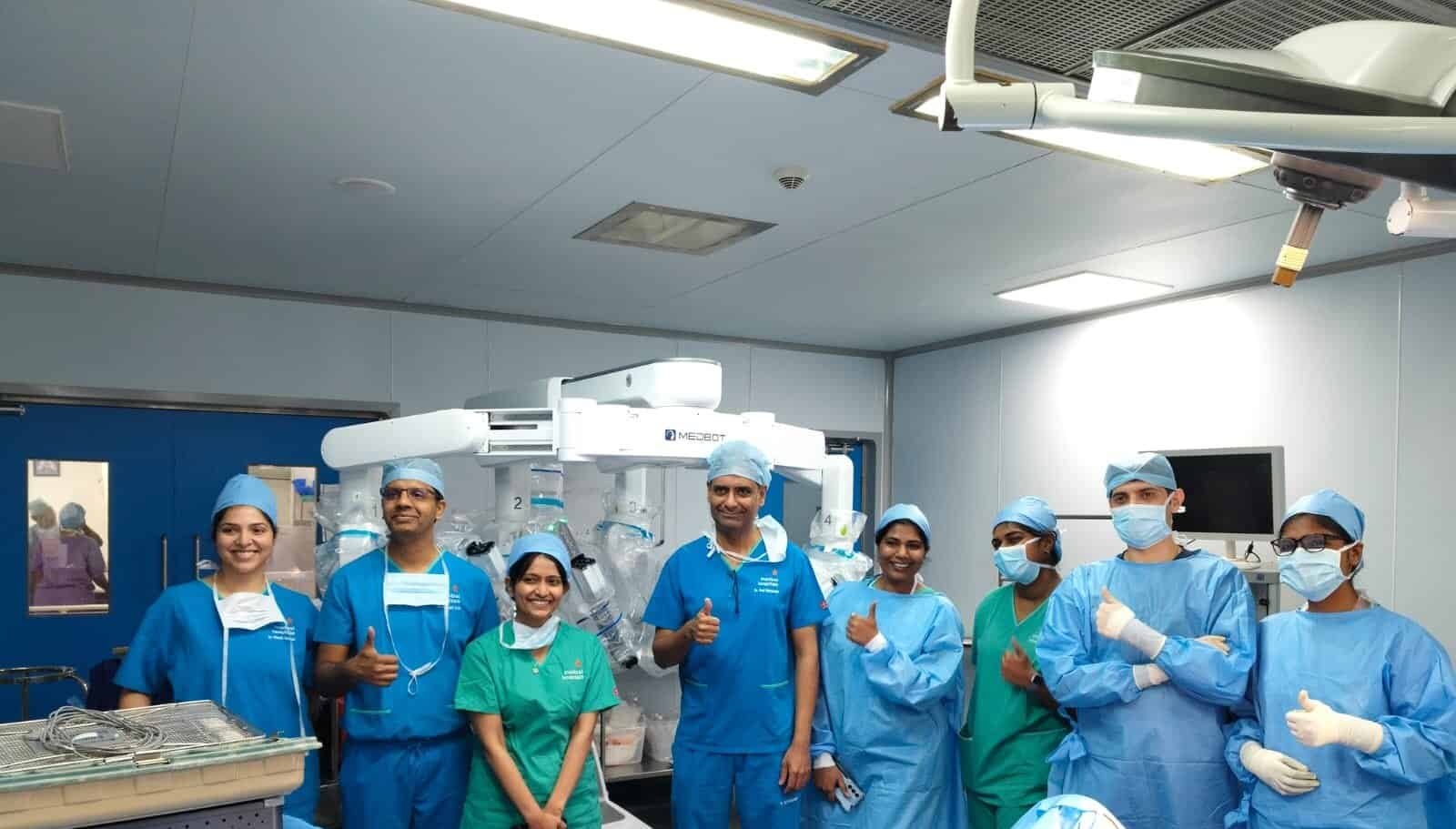
Some selected tumors can be approached through the mouth using endoscopic instruments, a laser or robotic technology. Transoral robotic surgery may provide access to certain tumors without a large external incision, but it is not suitable for every laryngeal cancer.
The decision depends on:
Laparoscopic surgery is generally not used for laryngeal cancer because laparoscopy is designed mainly for operations inside the abdomen or chest.
Open surgery remains necessary for many partial and total laryngectomies, extensive tumors and operations involving the neck. An open operation is not an inferior choice when it provides safer removal and better cancer control.
You can learn more about Robotic Cancer Surgery, Minimally Invasive Cancer Surgery and Open Cancer Surgery before your consultation.

I will review your biopsy, scans, stage, medical conditions and previous treatments. Additional tests may be requested if they could change the operation or improve safety.
Depending on the planned surgery, preparation may include:
If a total laryngectomy is being considered, you and your family should understand how breathing, speaking and stoma care will change after surgery. Meeting a speech and swallowing therapist before the operation can make this adjustment easier.
The length of stay depends on the operation and your recovery. A limited endoscopic procedure may require a short admission. Partial or total laryngectomy usually requires a longer stay.
During hospitalization, the team monitors breathing, pain, wound healing, swallowing and nutrition. Feeding may temporarily be provided through a tube while the throat heals.
Recovery varies considerably. Patients undergoing limited surgery may return to routine activities sooner than patients undergoing open or total laryngectomy.
You will receive guidance regarding:
Speech and swallowing rehabilitation can be essential. Improvement may continue over several weeks or months.
The removed tumor and lymph nodes are examined by a pathologist. The report provides information about:
The report is discussed in detail. If additional radiation or chemoradiation is recommended, the reasons and timing will be explained.
You may also read Recovery After Cancer Surgery to understand the general recovery process.

There is no single fixed cost for laryngeal cancer surgery because the treatment can range from a limited endoscopic procedure to a total laryngectomy with neck dissection and reconstruction.
The cost of laryngeal (voice box) cancer surgery in Bangalore may depend on:
A realistic estimate can be prepared after the surgeon reviews the biopsy, scans and planned procedure. It is also helpful to ask what the estimate includes and which expenses may be billed separately.

I currently consult at:
These centers provide access to comprehensive cancer care within a well-equipped hospital environment, supporting multidisciplinary treatment, investigations, and post-operative care when required.
Consultation timings and appointment details can be arranged through phone or WhatsApp for convenience.

This page has been written and medically reviewed under the guidance of Dr. Suraj Manjunath, Senior Surgical Oncologist at Apollo Hospitals, Bannerghatta Road, Bangalore.
The information has been reviewed for medical accuracy, patient clarity, and relevance to cancer surgery decision-making. Cancer treatment is always personalized and depends on factors such as the type of cancer, stage or spread of disease, overall health, co-morbidities, test results, and treatment goals.
The information is meant for patient education and should not replace an in-person consultation, diagnosis or personalized treatment plan.
Consultation Locations: Apollo Hospitals, Bannerghatta Road & Sarjapur Road, Bangalore.
Last reviewed: September 2026
