
My medical training was in an era when Minimal Access Surgery was still in its infancy. During my general surgical residency starting in the late 90s, with the limited available technology, there were attempts by my teachers to perform minimal access techniques – but “Big surgeons make big incisions” was still the norm.
By the time of my surgical oncology training, minimal access surgery had become quite prevalent in general surgery. But as cancer surgeons, we faced two specific challenges. First, the common basic minimal access surgeries that surgeons initially learn are typical procedures like laparoscopic cholecystectomy (removal of the gall bladder) or appendectomy (removal of the appendix). But in a cancer center like the one I trained in, we did not do those surgeries. In fact, there are very few “basic” minimal access procedures in the field of surgical oncology – for us, the most common basic surgery was a diagnostic laparoscopy or thoracoscopy and biopsy. Anything more than that would involve complex resectional techniques. And without the experience of minimal access general surgery, it was difficult for us to directly perform advanced minimal access cancer surgeries. Luckily for me, after my surgical oncology training, I worked at an institution which mandated that I, in the initial couple of years, do some general surgical work as well. I happily used that opportunity to perform many easier general surgical minimal access procedures, enabling me to then progress to minimal access surgical oncology as well.
The second challenge was that of scientific evidence. Twenty to twenty-five years back, there was not enough evidence that minimal access surgery would provide the same cancer cure rates as conventional open surgery. This made many of us hesitant to offer minimal access surgical procedures until enough evidence accumulated over the years, for specific cancers.
In the previous decade, we also witnessed the advent of robotic surgery – a newer form of minimal access surgery. The challenge here, surprisingly, was not gaining technical proficiency. While the earlier minimal access surgeries (laparoscopy and thoracoscopy) are difficult to master, robotic surgery is by design, quite easy to learn. The surgical robot may be a cumbersome tool, but once the initial steps of getting the robot hooked up to the patient (deciding on the port positions and “docking”) are done, the surgical procedure itself is technically much easier. But the challenge for many of us was that of access. Being expensive machines (at least by Indian standards) and requiring expensive maintenance, in the beginning, very few Indian hospitals acquired surgical robots. Although my own initial exposure to surgical robots was in 2011, in the United States, it was quite some time later that I could actually start doing robotic surgeries in India.
The number of surgical robots installed in India is steadily increasing. And it is a great pleasure to see many young surgeons master minimal access as well as robotic surgeries early on in their career.
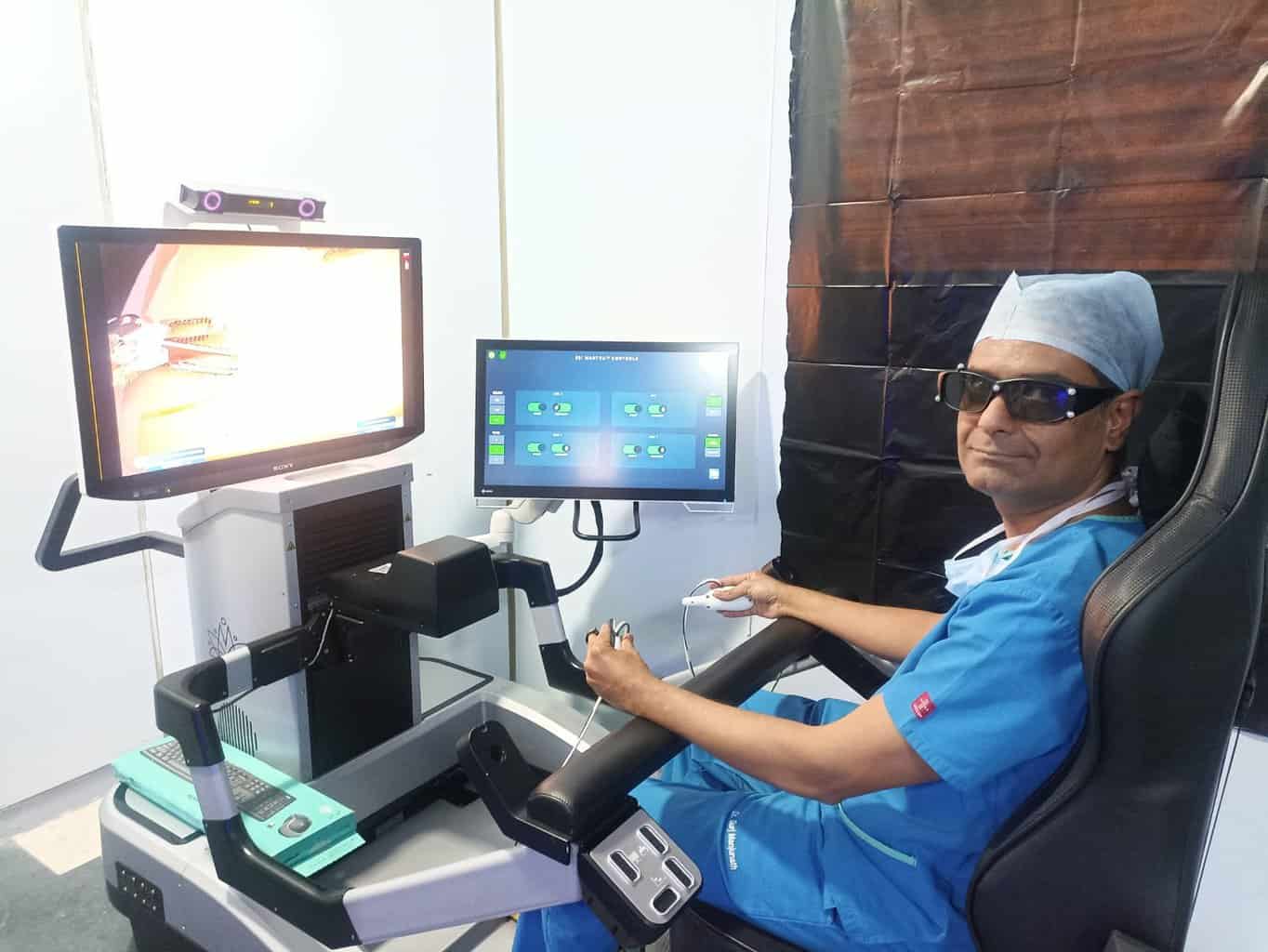
Recently, for the first time, I even got to use an Indian made robot – the SSI Mantra (picture above). It remains to be seen whether the significantly lower costs will make robotic cancer surgery more accessible to patients. Yes, the new robot meant that I had to again undergo some training to familiarize myself with the different aspects of this robot.
But as the Red Queen said in Lewis Carroll’s “Through The Looking Glass”, “Now, here, you see, it takes all the running you can do, to keep in the same place. If you want to get somewhere else, you must run at least twice as fast as that!”

Rosemary Isaac says:
It’s true, we have to run twice as fast these days to get anywhere, with changes happening at a disorienting pace. We need to keep up with the developments in our field, particularly doctors. It is not about ambition but about helping others better and serving society better. An article that is very relevant to our times.